Monday, 21 June 2010

Top UK PR & Social Media People


I have recently updated my two (yes two – one is simply not enough) Twitter lists of the top UK based people who work in PR or Social Media or both and who are worth to follow.


Both of these lists contain people who love Twitter and PR & Social Media as much as I do. If you want to follow one, feel free to do so. I'd recommend you to follow them both though...so you won't miss anyone.
I intend to update them both regularly and if needed I will start another Twitter list (this is actually quite likely to happen soon).
Please let me know if I’ve missed someone special or if you think you should be on the lists too :)

Wednesday, 9 June 2010

University? Done! :D

I’m happy & proud to announce that my last exam took place on Tuesday, 1st June. I am free now! I am not a graduate yet (don’t have my title) but I am done with University – it feels so good...
PR class of 2010

Just one quick look at my ikea bookcase reveals about 12 books that still need to be returned to the library (plus fines to be paid - ups) and 8 books that I actually own but will never ever need in my life. I can bet all my imaginary millions on it!


On the other hand there are about 15 books that I love (Deirdre Breakenridge: PR 2.0: New Media, New Tools, New Audiences, and other PR books). HA, I’ve joust found a list of ‘TO READ’ books:

  • Deirdre Breakenridge: Putting the Public Back in Public Relations: How Social Media Is Reinventing the Aging Business of PR
  • Brian Solis: Engage
  • Charlen Li & Josh Bernoff: Groundswell
  • Jim Macnamara: The 21st Century Media (R)EVOLUTION
  • David Phillips & Philip Young: Online Public Relations
Hmm, maybe one day. Will have to check them on ebay soon :) If anyone has a spare copy of any of these, please let me know.

Other part of the bookcase is full of sheets of paper filled with my notes in every possible colour and mind maps on everything and anything (some nicely stapled together, some lying freely on top of each other), notebooks and colourful file folders that contain 3 years of my life (well, some more filling is still needed to be done – I’ve just looked at my desk (*sight*).

This is actually quite upsetting: University is done! What now? What people do with all this stuff?? 

The last semester flew by so fast! I didn’t really get ready for the end of it, I admit. Everything was very hectic and intense in many ways. I was forced to multitask more than ever before: attending lectures and seminars, meeting deadlines for University assignments, getting group work going, applying for PR Grad jobs, looking for part time jobs, educating myself about the new digital tools and social media, blogging, tweeting, and many more. I don’t know how to ‘unitask’ anymore.

No surprise then that it feels weird to have time for the ‘things’ that I like to do like cooking, reading books, drawing, city browsing, etc. These activities have been banned from my life for a very long time. Well, let’s see how I get on with them. 

My top priority is to find a job now. I just need to catch my breath first.

Tuesday, 18 May 2010

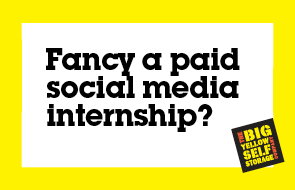
BIG THINK – paid, one month summer internship at Big Yellow anyone?


The closing date is 11 June 2010 ... But enter now if you really want it!
“Big Thinkers Wanted at Big Yellow” – Big Yellow Self Storage is looking for their summer 2010 intern who will join their communication team in London. Absolutely anyone can apply! Well you must fancy Social Media of course.
How to enter? Simply visit facebook.com/bigyellow and submit your news headline including the words “Big” and “Yellow”.
How easy is this? No need for long essays, no need to answer: "Why do you think we should pick you?” or "What for you was the biggest PR disaster during 2009 and how would you have handled it differently?" types of questions...
So what are you still waiting for?

Saturday, 17 April 2010

Twitter kicks off promoted tweets


So, Twitter launched the advertising platform this week. Companies like Starbucks and Virgin have signed up for the service straights away. I noticed these three today:
 I find it quite weird. It is a form of advertising, no doubt about it, but why when I click on the "Promoted by XY" ,just below the particular tweet, it takes to me to "FAQ: Promoted Tweets". Shouldn't it take me to the brand's home website? I am the target audience, not a potential advertiser...

Wednesday, 14 April 2010

PR Spam: PROs know what to do now, what about Journalists & Bloggers? Do you have an opinion? Share it then...

Journalists and Bloggers have been complaining about being spammed by irrelevant and often unsolicited PR communication for ages. This bad practice is as old as Public Relations itself. The nature of the relationship between PROs and journalists (and bloggers since the introduction of Web 2.0) is sometimes quite difficult to define. Some say that PROs need journalists as much as journalists need PROs. So this should be a win-win relationship then, right? Apparently it isn’t.

The Inconvenient PR Truth campaign has brought to light a ‘bill-of-rights’, set of 10 demands on behalf of journalists. In my opinion, the most important ones are the first three, the rest of the rules follow from these three. These are: Permission required, Timely unsubscribe, Don’t rely on media lists exclusively.

By following these simple three rules when trying to sell a story to the media, a PRO can not only manage to do so, but also build his/hers reputation as a rational and sensible person who does the research and respect the journalists’ side ... simple as that. If you behave more like a human and less like a machine, you will get the results your client requires.

Thanks to the ‘bill-of-rights’ PROs know what to do, but what about the journalists and bloggers?

Journalists & bloggers are very good in complaining, posting shame-lists of names on their blogs and spending (and wasting) time on keeping this issue alive. What if they also made a step forward and published their key interests and topics they like to cover on their websites and blogs? Some of them have done it already, but some are still resistant to make the step and remain in the phase of complaining and moaning. This could save them valuable time (currently spent on deleting irrelevant PR pitches & Press Releases and complaining about it in their blogs) and actually improve their work. I said “could” because not all PROs’ ethics are the same. Some just generally don’t care.

Here I am, trying to get some response from the journalists & bloggers and PROs on the issue of PR Spam for my final year PR project. I thought that it was going to be much easier than it actually is. It seems like my target audience has no opinion! Is it even possible?

Journalists & Bloggers – please find the time to complete this 10-question survey on PR Spam. I need your opinion to find out the possible solutions to this issue. You have been complaining for quite long now, now is the time to make the next step.

PROs – do you think that journalists are right to complain about sending out PR communication in bulk? Or maybe you think that they should do something to improve your relationship... Let me know in this 10-question survey on PR Spam please.

Alternatively, feel free to email me with your thoughts on the issue.

Thursday, 18 March 2010

It is more than PR Spam...

I’ve started getting into the issue of PR Spam and I must say that I‘ve reached the point, when I just hate to call it this way, It is because I think that the term doesn’t really capture the nature of the issue.
Definitions of spam on the Web are very diverse yet similar:
  • A common synonym for spam is unsolicited bulk e-mail (UBE).
  • Spam is the abuse of electronic messaging systems (including most broadcast media, digital delivery systems) to send unsolicited bulk messages indiscriminately.
  • A collection of unsolicited bulk electronic messages; Any undesired electronic content automatically-generated for commercial purposes
  • Indiscriminately send unsolicited, unwanted, irrelevant, or inappropriate messages, especially commercial advertising in mass quantities.
  • Unwanted, unsolicited email
So I am asking, what about the unwanted and irrelevant DMs on Twitter? The unnecessary and annoying phone calls and text messages? Other forms of information received without people requesting them? Based on the definitions of ‘spam’, the PR issue is not just PR Spam. It is more complex than that. In my opinion, the key aspects of what we call ‘PR Spam’ are:
  • Inappropriate targeting => resulting in sending information in bulk
  • Laziness to do the initial media campaign research => resulting in sending information in bulk
  • Unrealistic expectation on PROs to meet crazy objective (i.e. every day coverage in the FTs) = causing high level of stress on the PRO to get some coverage => resulting in sending information in bulk
  • Lack of appropriate education=>causing low practical PR skills=> resulting in sending information in bulk
  • Expensive media training courses => little chance that a PRO will attend => resulting in sending information in bulk
I get it, journos and bloggers are angry because their email in-boxes are full of irrelevant information but they need to see the reality of being on the other side too. (I intend to cover this in my next blog post)
The campaign “An Inconvenient PR Truth" covers 10 demands on behalf of journalists and bloggers - “bill of rights: 
Are these purely about finding ways how to stop PROs from spamming journalists and bloggers? I don’t think so. It seems like the problem is hidden much deeper – in the nature of the ‘PRO – Journalist’ relationship.

I have noticed that some people are trying to cash out on this hot issue and came up with training seminars, webinars, blogs, and who knows what else. Here is an offer to ‘attend’ a webinar on how to deal with the media, in particular how to pitch journalists in the new media world. It will cost you ‘only’ $99!!! Is this helping?

‘CIPR training, qualifications and seminars for PR& communication professionals’ booklet offers only two workshops on basic level on how to deal with the media.
  • Selling-in your stories (£350 + VAT for CIPR members, £455 + VAT for non-members)
  • Working with the media (£350 + VAT for CIPR members, £455 + VAT for non-members)
 I am not entirely convinced that these two workshops are tailored to the needs of the journalists though.
So as I said above, the so called ‘PR Spam’ is more than that. PROs should think before they hit send. Do you all remember the definition of PR?
"Public Relations is the planned and sustained effort 
to establish and maintain goodwill and mutual 
understanding between an organisation and its publics."
  (CIPR)